Guides / Coloring and development
Toddler attention span by age, and what coloring can do
A 2-year-old who colors for two minutes and wanders off is doing exactly what 2-year-olds do. The one attention milestone on the CDC's checklists comes at 5: a child pays attention for 5 to 10 minutes during activities such as story time or arts and crafts, and the CDC adds that screen time does not count. Younger kids get there gradually, a minute or two at a time, and they stay longest with something they chose, often with a grown-up sitting next to them.
What is normal at each age
You will see a rule online that a child can focus for two to three minutes per year of age. It is a handy rough guess, but it is not on the CDC milestone pages, and I could not trace it to a study. Here is what the sources actually support.
| Age | What attention usually looks like | What the sources say |
|---|---|---|
| 1 to 2 | Short looks at a toy, longer when a parent looks at it too | One-year-olds extended their attention to a toy right after a parent looked at the same toy |
| 2 to 3 | A few minutes on a chosen activity, then a switch | Individual differences show up early and inattention at 2 predicted similar measures at 3 and a half in one long-term study |
| 3 to 4 | Longer stretches on drawing and pretend play | By 4, the CDC lists drawing a person with three or more body parts, which takes planning and staying with a page |
| 5 | 5 to 10 minutes on a story or a craft | The CDC milestone, screen time not included |
Two cautions on reading that table. First, the middle column describes lots of kids, not a target. Second, the long-term study found children differ from each other in a fairly stable way. Some toddlers are naturally busier than others. That is temperament, not a grade.
What the research says about helping attention grow
Sitting with them helps. The most practical finding comes from a study that put small eye-tracking cameras on one-year-olds and their parents during toy play. When the parent looked at the same toy the baby was already looking at, the baby kept looking at it longer afterward. The authors argue that sustained attention grows partly through shared attention, not only from inside the child. That study was about babies and toys, not preschoolers and crayons, but the everyday version is simple: color next to your kid and look at what they are doing.
Clutter competes. In a lab classroom study, kindergartners spent more time off task and learned less when the walls were heavily decorated than when the decorations were taken down. A kitchen table covered in toys, mail and an open tablet is a small version of that wall.
Start short and build. St. Jude's rehab team tells families that a child may only do an activity for a short time at first, and to work on increasing the time they spend on it. The same page notes that kids who are having fun are more likely to finish.
What the research does not show: I could not find a study that tested whether coloring in particular lengthens attention span. Coloring is one of many things a child can practice sticking with, alongside puzzles, block towers and listening to a book. The case for it is that it is cheap, quiet and easy to adjust, not that it trains attention better than anything else.
How to use coloring to stretch focus
These steps cost nothing and work with any page:
- Clear the table. One page, a few crayons, nothing else in view. Put the tablet in another room, not face down next to the paper.
- Make the page small enough to finish. An NHS Wales occupational therapy handout on coloring advises keeping areas to be colored small and achievable, then gradually increasing the size of the pictures as patience and skill grow. Finishing is what makes a child want to start the next one.
- Sit down and color too. Your own page, next to theirs. Comment on what they are doing ("you made the dog blue") rather than quizzing them.
- Let them choose. Two or three pages to pick from works better than one handed over. A choice is a reason to stay.
- Stop on a good note. End the session while it is still going well, even at three minutes. The next one starts easier.
- Notice the minutes, not the neatness. Staying in the lines comes late; there is more on that in coloring inside the lines.
A drawing or coloring session also counts toward hand practice, which is covered in does coloring help fine motor skills.
Pages that hold attention longer
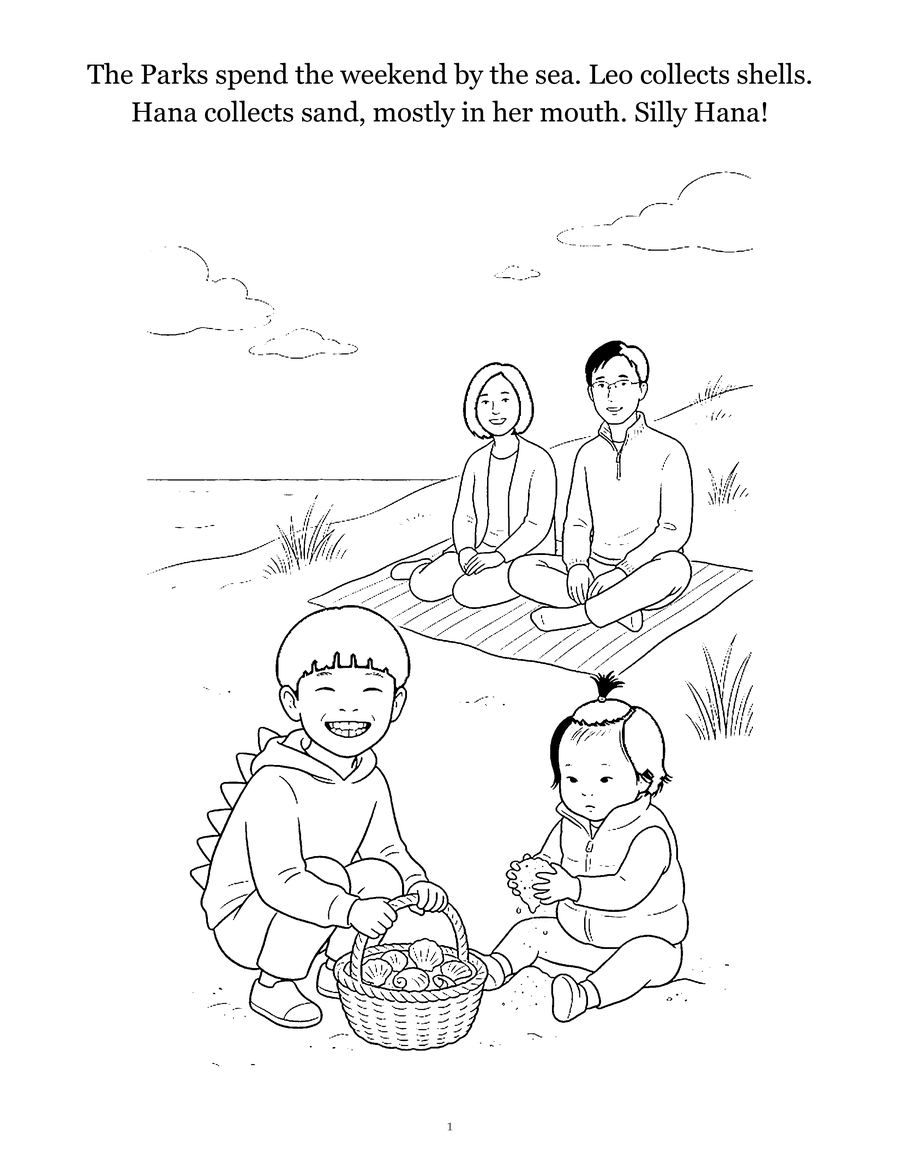
Subject matter is the easy lever. A kid who loves trucks will stay with a truck. Many kids stay longest with pictures of themselves, their pets or the people they know. My own two come back to the pages that show them, and that is the reason I made the first coloring storybook for them.
You can test this for free by turning a family photo into a coloring page and seeing whether it outlasts the cartoon. If it does, a personalized book like Colorkin, which is drafted from your photos with image tools and checked by a person, is one option; a homemade stack of photo pages works too.
Coloring versus screens for focus
A screen can hold a toddler's eyes for a long time, which is exactly why the CDC does not count it. Watching is not the same as a child steering their own attention. That is a reason to keep low-key activities like coloring in rotation, not a reason to panic about every show. For a practical plan, see screen time vs coloring. For using a coloring page to help a child settle after a hard moment, see coloring for calm.
When to talk to your pediatrician
Short attention in a toddler is normal. Even ADHD is rarely the question this early: the AAP's diagnosis guidelines are written for children 4 to 18 years of age, and the AAP says it is difficult to diagnose ADHD before 4 because young children change so quickly. If your child cannot settle into any activity for even a minute or two, seems to be losing skills, or is struggling at preschool, bring it up at the next checkup and ask what to watch for.
More age-by-age guides are collected under coloring and development.
Questions parents ask
How long should a 3-year-old focus on one activity?
There is no official number for 3. The CDC's milestone is that by 5 a child pays attention for 5 to 10 minutes during activities like story time or crafts, so a few minutes at a time is typical for a 3-year-old, longer when the activity is one they chose.
Does coloring improve attention span?
No study has shown that coloring itself lengthens attention span. It is one of many activities where kids practice staying with something, and practice is easier when the page interests them and an adult is nearby.
Is a short attention span at 2 a sign of ADHD?
Not on its own. Short bursts of attention are normal at 2. The AAP's ADHD diagnosis guidelines are written for children 4 to 18, and the AAP says ADHD is difficult to diagnose before 4. If you are worried, talk to your pediatrician.
Does screen time count toward attention span?
The CDC says no. Its 5-year milestone of paying attention for 5 to 10 minutes gives story time and arts and crafts as examples and says screen time does not count.
See your own family on a page, free
Kids stay longer with a page they care about. Send one photo and we will draw a free coloring page of your family, no card needed.
Get a free sample page- CDC, Milestones in Action: By 5 Years
- CDC, Milestones in Action: By 4 Years
- Yu and Smith, The Social Origins of Sustained Attention in One-Year-Old Human Infants, Current Biology 2016
- Ruff et al., Long-term stability of individual differences in sustained attention in the early years, Child Development 1990
- Fisher, Godwin and Seltman, Visual environment, attention allocation, and learning in young children, Psychological Science 2014
- Aneurin Bevan University Health Board (NHS Wales) Children's Occupational Therapy, Colouring Development
- St. Jude Together, Therapy to Go
- HealthyChildren.org (AAP), Diagnosing ADHD in Children: Guidelines and Information for Parents
More in Coloring and development
When do toddlers recognize themselves in mirrors and photos?
Babies enjoy mirrors by 6 months, but most recognize themselves around 18 to 24 months, and photos of the past make sense later. What the mirror test shows.
When do toddlers learn colors? Ages, mix-ups and how to help
Most toddlers know one color by 30 months and name a few by 4, per the CDC. Why color words come slowly, why mix-ups are normal, and easy ways to help.
When can toddlers start coloring? Ages, grips and first steps
Most kids scribble by 18 months, copy a circle around 3 and hold a crayon in their fingers by 4. What to expect at each age and how to start.